A Medieval Foundation on the Great Road
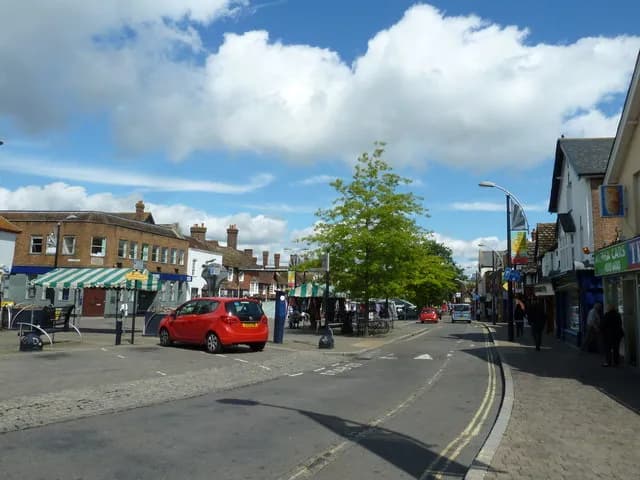
The George Hotel on Crawley High Street ranks among the town's oldest and most architecturally significant buildings. Its core structure dates from the late 15th or early 16th century, with a stone fireplace bearing the date 1615, although historians note this may have been added later. First documented in 1579 in the land tenure records of Richard Covert, the inn occupies a strategic position on what is now the A23: the historic London to Brighton road. It was granted Grade II* listed status on 21 June 1948 and is widely regarded as Crawley's most celebrated building.
The Premier Coaching Inn
By the late 18th century, the George was recognised as the principal halfway house between London and Brighton. The opening of the turnpike road in 1770 and the subsequent rise of Brighton as a fashionable seaside resort transformed Crawley into a bustling staging post. By 1839, approximately 60 coaches passed through the town daily, and the George Hotel, with its extensive stabling and accommodation, held what contemporary accounts described as the premier position among Sussex inns. The building expanded over the centuries by absorbing adjacent properties, including an annex that once stood in the middle of the High Street and was demolished in 1933.
Royal Visitors and National Celebrations
The hotel's guest book reads like a ledger of British history. Lord Nelson is known to have stayed at the George; his sister lived in nearby Handcross, and the admiral's presence is recorded in local histories. The Prince Regent, later George IV, was a regular traveller on the London-Brighton road and used the hotel as a base when visiting Crawley Down and Copthorne for bareknuckle prizefighting. Queen Victoria was stranded overnight at the George when her carriage broke down, though she was accommodated in the annex rather than the main building. In 1863, the wedding of Edward, Prince of Wales, to Princess Alexandra of Denmark was celebrated at the hotel in an event organised by Mark Lemon, the first editor of Punch magazine and a Crawley resident.
Literary Connections
The George Hotel occupies a notable place in English literature. Sir Arthur Conan Doyle made the inn central to the plot of his 1896 novel Rodney Stone, a mystery set in the world of bareknuckle prizefighting. In the book, Doyle described "the high front door of the old George Inn, glowing from every door and pane and crevice, in honour of the noble company who were to sleep within that night." The earliest artistic depiction of Crawley, an 1789 aquatint by Thomas Rowlandson entitled An Excursion to Brighthelmstone, also features the hotel. Mark Lemon, who lived on Crawley High Street from 1858 until his death in 1870, is commemorated by a blue plaque outside the building.
Crime and the Darker Side of the Road
The hotel's history is not without its shadows. In the 18th century, the George benefited from the local smuggling trade; horses seized from smugglers were reportedly auctioned outside the inn beneath a set of gallows that later became a landmark inn sign. More chillingly, the hotel is linked to one of Britain's most notorious 20th-century murderers. John George Haigh, the so-called "Acid Bath Murderer," stayed at the George on numerous occasions and dined there on 12 February 1948, the same day he killed his victim Archibald Henderson. Haigh rented a workshop at 2 Leopold Road, Crawley, where he disposed of bodies in sulphuric acid. The hotel is also reputed to be haunted by a nightwatchman named Mark Hurston, who local legend claims died from poisoned wine.
From Coaching Inn to Modern Hotel
Despite Crawley's designation as a New Town in 1947 and the subsequent rapid development of the surrounding area, the historic High Street and the George Hotel were preserved. The building has been adapted over time and now operates as the Ramada Crawley Gatwick, offering 84 bedrooms, conference facilities and a restaurant. It remains one of only 12 Grade II* listed structures in the borough and one of six listed buildings in the West Green neighbourhood.