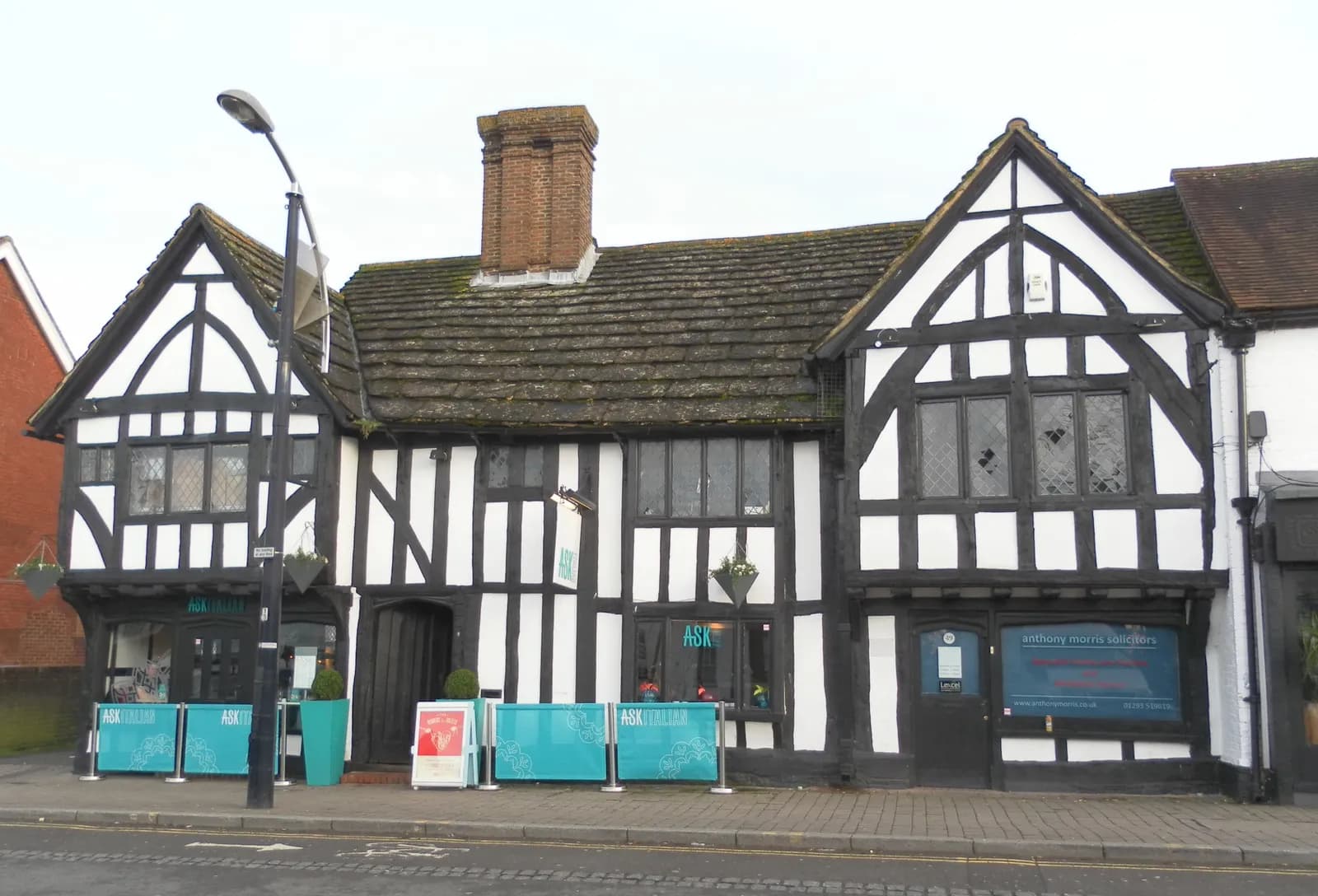
Tucked between shopfronts on Crawley High Street stands one of Sussex's most significant medieval buildings, its timber frame concealing chambers that once sheltered Catholic priests during the Reformation.
A Wealden Hall House on the High Street
Ancient Priors occupies numbers 49 to 51 High Street, its distinctive silhouette of gabled cross-wings and jettied upper storeys visible to passers-by. The building represents a rare survival: a Wealden hall house constructed circa 1450, with a south-facing wing dating to the 14th century that makes it the oldest structure on Crawley High Street.
The main block follows the classic hall house plan, originally built with an open central hall that rose the full height of the building. In the 16th century, owners inserted an upper floor into this space and added a central chimney stack with stone fireplaces on both levels. A south-eastern wing joined the structure around 1530, creating the L-shaped plan visible today. The roof retains its Horsham slab tiles, made from clay dug in the local area, while inside, moulded crown posts, arched braces, and decorative panelling survive from the original construction. Historic England, which listed the building Grade II* in June 1948, described the internal timber work as "very superior" for north Sussex.
Priest Holes and Reformation Secrets
The building's connection to the Reformation emerged during renovation works in 1881, when workmen converting the property to a Temperance Hotel made an extraordinary discovery. Hidden rooms, accessed through a trapdoor released by pulling a meat hook in a passageway and a fireplace that swung outward when a carved mantelpiece detail was twisted, lay concealed within the structure.
Evidence indicates these chambers served as hiding places for Roman Catholic priests during the Reformation, when public Catholic worship was banned in England. The building is also reputed to have served as a pre-Reformation priest's house associated with St John the Baptist's Church in Crawley. Local tradition further suggests smugglers from nearby Copthorne, a known 18th and 19th-century smuggling hub, later used the spaces to store contraband.
From Private House to Public House
The building's documented ownership begins in 1608, when a local collier family acquired the property. By 1668, it had become the White Hart inn, operating with barns, an orchard, and garden. The Brett family sold the building in 1753 for £473, a sum equivalent to approximately £90,700 in today's terms.
The 20th century brought several transformations. In 1911, antiques dealer Mr Parkhurst purchased the building, renaming it "The Ancient Priest's House" (later shortened to Ancient Priors), exposing the internal timber work, and installing medieval-style windows. When local shopkeeper Harry Charman bought the derelict structure in 1937, he faced a choice: develop the site or preserve the building. He chose preservation, dividing it into three units comprising a tearoom, sweet shop, and hairdresser.
World middleweight boxing champion Alan Minter acquired the restaurant in 1977, operating it as "Minter's Restaurant & Wine Bar" until 1980. The building subsequently housed various restaurants, most recently an ASK Italian outlet.
A Darker Chapter
The building's history includes a connection to one of England's most notorious criminals. John George Haigh, the serial killer known as the "acid-bath murderer," entertained his victim Olive Durand-Deacon to tea at Ancient Priors in the 1940s during visits to his nearby workshop on Leopold Road. Durand-Deacon became Haigh's final victim in February 1949.
Preservation and Public Access
Ancient Priors received its Grade II* listing on 21 June 1948, recognising it as a "particularly important building of more than special interest" of national significance. The designation protects the structure, which remains one of the finest surviving timber-framed medieval houses between London and Brighton.
Today, the building continues its centuries-old tradition of hospitality as a restaurant on Crawley High Street, offering visitors the opportunity to dine within walls that have witnessed nearly six centuries of English history.